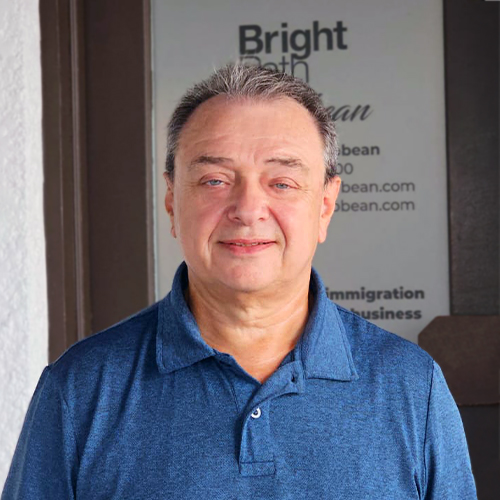
David Dolitsky holds a dual leadership role as Financial Controller of BrightPath Caribbean and General Manager of CaribTax. His path here wasn't a straight line from accounting school to advisor — it ran through the trenches of business ownership: healthcare (medical billing and DME supply), food service, real estate investment, and business brokering. He holds a Bachelor of Science in Accounting, but what shapes his work most is what he learned running companies, not studying them.
He is also an expat himself — he and his wife packed up and left the East Coast winters behind, landing in Sint Maarten without a job already lined up. That leap, and what followed, informs how he talks with every client considering the same move. We sat down with David to talk about his career, what he sees every day in the field, and the most important things any expat, investor, or business owner should understand about doing business on the Dutch Caribbean island.
I have a BS in Accounting, but honestly — I'm primarily a business owner. I've operated in healthcare (medical billing and DME supply), food service, real estate investment, and business brokering. That's where most of my real education happened: not in a classroom, but in the day-to-day grind of running companies across different industries.
The advisory work came naturally from that. I went through the complexity that my clients now face — entity structures, compliance obligations, financial controls, dealing with regulatory environments — and I came out the other side understanding what actually matters and what doesn't. I enjoy helping other business owners navigate the same terrain. I've been in their shoes.
When the opportunity came up in Sint Maarten, I could see immediately that there was a real need for structured financial guidance here. The island had plenty of basic bookkeeping options, but not the kind of comprehensive, cross-border advisory work that business owners and expats genuinely need. CaribTax was the vehicle to build that.
I'm Financial Controller of BrightPath Caribbean and General Manager of CaribTax. On any given day that means corporate tax filings, financial statement preparation, payroll compliance, and structuring advice for businesses and individuals across the island.
What drew me to the role was exactly what I described — Sint Maarten was underserved. The island needed more than basic bookkeeping. Clients here have complex situations: cross-border income, US or European home-country obligations still running in parallel, entity structures that interact with multiple jurisdictions at once. That requires a real advisory practice, not just someone filing returns.
The Penshonado program is a perfect example. It's a legitimate statutory benefit — a flat 10% tax rate on worldwide income for qualifying residents — and it's substantial. But accessing it correctly requires guidance. That's the kind of work I find meaningful: helping someone unlock a real benefit through proper process, not improvisation.
Most compliance problems start with poor recordkeeping, not bad intentions. People aren't trying to skirt their obligations — they just never put the systems in place to track things properly. When the filing deadline comes, they're scrambling to reconstruct what happened over the past year. That scramble is where errors and exposure get created.
Proactive planning is worth far more than reactive problem-solving. I've watched clients pay far more to clean up a structure that was never set up right than they would have paid to do it correctly from day one. Advisors who help you after the fact are fighting uphill — and billing for every step of it.
No two situations are alike. This is particularly true in Sint Maarten. Cross-border income, island jurisdictions, clients with home-country obligations still running alongside SXM obligations — cookie-cutter advice doesn't work here. You have to understand the full picture of each client's situation before you can give meaningful guidance.
Sint Maarten is not a tax-free paradise where you can operate loosely. People show up with that idea — that it's a small island, that enforcement is relaxed, that the rules don't really apply here. That's wrong. Sint Maarten has a real tax authority, real obligations, and real penalties. The size of the island doesn't reduce the seriousness of the tax code.
A foreign-registered company does not automatically shield you from Sint Maarten tax obligations. If your economic activity is happening here — if your employees are here, your clients are here, your operations are here — then your tax exposure may be here too. We see this mistake constantly: someone sets up an offshore or foreign company thinking it creates a wall between them and SXM tax. It doesn't, not without the right structure and proper analysis.
Not all accountants understand Dutch Caribbean tax law. This sounds obvious but it catches a lot of people. Someone arrives with a trusted accountant from back home, assumes they can handle SXM obligations remotely, and ends up with a filing that doesn't account for local requirements — loonbelasting, turnover tax, winstbelasting, the specifics of the Penshonado statute. This jurisdiction is specific. It requires local expertise.
Choosing the wrong entity type. People set up a BV without fully understanding how profit distributions work, what withholding taxes apply, and how the structure interacts with their home country obligations. The entity choice has lasting consequences — tax rate, liability exposure, exit planning. It needs to be made with full information, not just what's cheapest or fastest to register.
Co-mingling personal and business finances. This is the most common operational mistake we see. When business income flows through personal accounts and personal expenses show up in business records, there's no clean picture of anything — not for the owner, not for a bank, not for the Belastingdienst. It creates complications in every direction.
Not keeping Chamber of Commerce registrations current. Sint Maarten requires active maintenance of registrations, including annual filings. Letting these lapse creates downstream problems with banking, contracts, and regulatory standing.
Underestimating turnover tax from day one. Businesses are often surprised by the turnover tax (TOT) obligations that kick in from the first invoice. It's not income tax — it applies to gross revenue, not profit. Not planning for it from the start creates cash flow problems almost immediately.
This one is critical: dormant companies still have to file. A company that holds real estate with no rent income, or one sitting on a shelf waiting to be activated, still has profit tax and turnover tax filing obligations. Ignoring this leads to ex-officio assessments with substantial penalties and interest. "Dormant" does not mean "exempt."
Dormant companies in Sint Maarten are not exempt from filing. A company holding real estate or sitting inactive still carries profit tax and turnover tax obligations. Ignoring these leads to ex-officio assessments with substantial penalties and interest.
Because the decisions you make at the beginning lock in the structure — often permanently. Starting a business: the choice between operating as a sole proprietor, an NV, or a BV has lasting implications for your tax rate, your liability exposure, and how you'll eventually exit. These aren't choices you can easily reverse after you've been operating for two years.
Purchasing property: the transfer taxes and ongoing obligations flow from how you hold the asset. Real estate planning is tax planning — they're inseparable here. And for retirement, the Penshonado regime is genuinely favorable, but you have to qualify and you have to structure correctly upfront. The benefit doesn't apply retroactively.
Good tax planning isn't about finding loopholes. It's about making informed decisions before you commit. That's the framing I use with every client. The time to think carefully about structure is before you sign the lease, before you transfer the property, before you apply for residency. Not six months after.
The post-Hurricane Irma reconstruction created a sustained wave of demand that's still running. Real estate is active — both in the tourism corridor and for end-use buyers who want to live here full time. There's genuine construction and development activity on the island right now.
For entrepreneurs, there are real gaps. Professional services at a high level — technology-adjacent businesses, hospitality concepts that serve a sophisticated international market — these are areas where someone with the right background and the right plan can find traction. The island has a multilingual, internationally connected population and English is widely spoken. That's a real advantage.
Retirement is a significant opportunity category. The quality of life here is exceptional. You have a sophisticated international community, a strong food culture, real amenities — and the Penshonado program as a financial framework. People who've done the homework and arrive with realistic expectations tend to thrive here. Key word: realistic. The island will reward you if you come prepared and properly structured. Coming in with false assumptions about what it's like to operate here is where people get humbled.
My wife and I were done with East Coast winters. Simple as that. We made the decision, we packed up, and we came — without a job already lined up. We took the leap, landed on the island, and I found my role with CaribTax and BrightPath after arriving. That's how it actually happened.
My background helped. I came from compliance-heavy environments — healthcare in the United States is extremely regulated, and navigating that teaches you a lot about structured environments, documentation discipline, and what happens when you don't take obligations seriously. That translated directly to what I do here.
What I love about living here is the international community, the food culture, and the professional energy on the island. There's a real mix of people from everywhere, all building something. And living it myself — going through the residency process, the banking, the filings, everything — means that when a client asks me what it's actually like, I'm answering from experience, not theory.
Do your homework before you arrive, not after. The people who struggle are almost always the ones who landed first and started figuring things out on the ground. By then, you've already made commitments — on housing, on business activity, on banking — that may not be optimal from a tax or compliance standpoint. The research phase is the highest-leverage time you have.
Your home country still expects filings even after you relocate. This catches a lot of people off guard. US citizens, in particular, are surprised to learn that the IRS doesn't stop caring about them when they move to Sint Maarten. FBAR obligations, FATCA reporting, foreign income declarations — these don't go away. You need to understand both sides of the equation.
Get your legal residency and work authorization structured from the start. Don't operate in a gray area while you figure it out. Sint Maarten is small — the professional community is small — and your standing matters.
Build relationships. The island runs on personal connections. The way you get things done here, the way introductions happen, the way business gets referred — it's all relational. And come with a realistic budget. Consistently underestimated, that one.
We have a full team under one roof: a legal and tax attorney, a payroll specialist, bookkeeping specialists. Clients don't have to coordinate between separate firms or navigate who handles which piece. That integration matters — especially when a client's situation touches multiple areas at once, which most of them do.
We actually know this jurisdiction. The landsverordeningen, the loonbelasting system, the TOT, winstbelasting — these aren't theoretical for us. We file here every day. We have active relationships with the local tax authority. We know how the rules are applied in practice, not just how they read on paper. That's a real difference.
And we have cross-border perspective. Most of our clients are connected to the US, Europe, Canada, or other Caribbean jurisdictions. They're not purely SXM situations — they have obligations running in multiple places simultaneously. We understand that intersection and we can advise across it. That's not something every local firm can offer.
Get in Touch with CaribTax
Whether you're planning a move, structuring a business, or exploring the Penshonado program — reach out to our team directly. We'll get back to you promptly.
Contact CaribTax →This interview is for informational purposes only and does not constitute legal or tax advice. Tax law is complex and individual circumstances vary. Consult a qualified Sint Maarten tax professional for advice specific to your situation.